
Best Pour Over Coffee Maker: 2026 Guide
Finding the best pour over coffee maker is less about buying the most expensive brewer and more about matching the design to your brewing style. For many newcomers, the best pour over coffee maker for beginners is simple, forgiving, and easy to clean, while experienced coffee drinkers may want more control over grind size, water flow, and extraction.
Whether you want a single cup, several servings, a reusable filter, or a plastic-free setup, there is a brewer that fits. In this guide, we’ll compare the most useful options so you can choose confidently.
Best Pour Over Coffee Maker for Beginners
For beginners, a forgiving brewer can make the learning curve much easier. The Hario V60 is one of the classic choices because it is affordable, widely available, and gives you plenty of control. However, its open design also makes pouring technique important.
The Kalita Wave is another excellent starting point because its flat-bottom design and restricted drainage make it less dependent on perfect pouring. Coffee enthusiasts often describe it as more forgiving than a V60, while still producing a clean and flavorful cup.
If you want even more flexibility, the Hario Switch is worth considering. It combines a V60-style brewer with an immersion mechanism, allowing beginners to start with a more forgiving method and gradually experiment with traditional pour-over brewing.
Best beginner choices:
- Hario V60: Best for learning precise pouring
- Kalita Wave: Best for consistency and easier brewing
- Hario Switch: Best for beginners who want flexibility
- Chemex: Best for attractive presentation and larger batches
Best Pour Over Coffee Maker for Multiple Cups
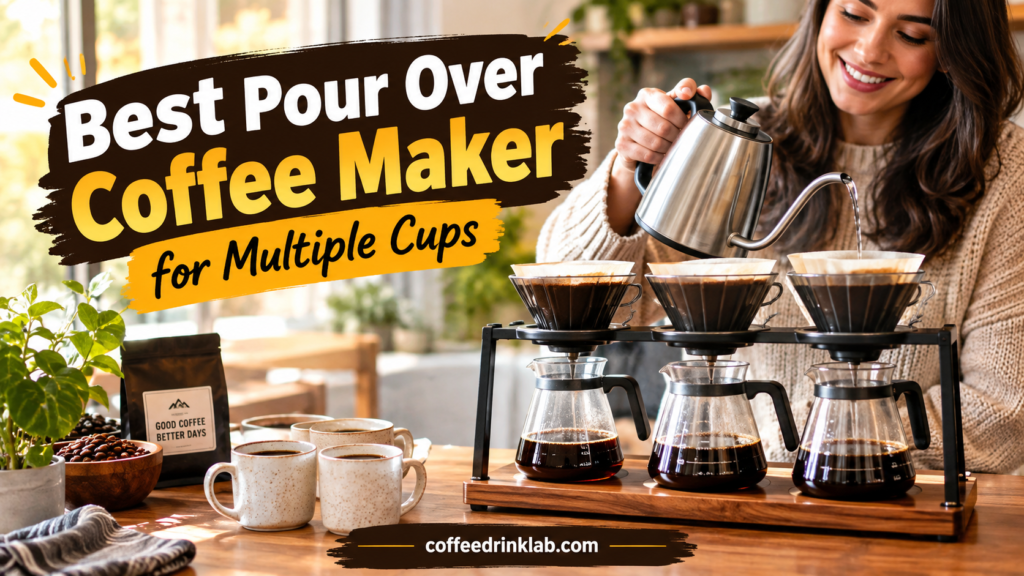
If you’re regularly brewing for family, friends, or guests, capacity becomes just as important as flavor. A small single-cup dripper can become frustrating when everyone wants coffee at once.
The Chemex is especially well suited to larger batches because its glass carafe acts as both brewer and serving vessel. Its thick paper filters also produce a notably clean cup by retaining more oils and fine particles. Coffee communities frequently recommend larger Chemex models when brewing for groups.
The larger Kalita Wave and Origami brewers are also useful when you want more coffee without moving to a fully automatic machine. However, always check the brewer’s recommended capacity and matching filter size before buying.
| Brewer | Best use | Typical strength |
|---|---|---|
| Hario V60 | One to two cups | High control |
| Kalita Wave | One to several cups | Consistent extraction |
| Chemex | Multiple servings | Very clean cup |
| Origami | Flexible batch brewing | Versatile |
| Hario Switch | Small to medium batches | Forgiving |
Reusable Filter Options
Reusable filters appeal to coffee drinkers who want to reduce disposable paper waste. They can also change the character of the coffee because metal or permanent filters generally allow more oils and fine particles into the cup.
That can produce a fuller-bodied drink compared with a paper-filtered pour over. On the other hand, reusable filters require more careful cleaning, especially if coffee oils build up over time.
A reusable-filter brewer can be a good choice if convenience and waste reduction matter more to you than achieving the extremely clean flavor associated with thick paper filters.
When choosing one, look for:
- A durable stainless-steel mesh
- Easy access for cleaning
- A stable base
- A filter size that matches your desired serving volume
- Minimal areas where grounds can become trapped
Plastic-Free Brewing Options
For shoppers specifically looking for the best pour over coffee maker no plastic, glass and ceramic designs are attractive options. A glass Chemex, for example, uses a glass brewing vessel, while ceramic V60 and Kalita models provide another route for reducing plastic components.
However, “no plastic” can mean different things depending on the product. Check the entire brewer, including its handle, base, filter holder, lid, and accessories, rather than assuming that a glass or ceramic body means every component is plastic-free.
Material also affects handling. Glass is visually appealing and lets you watch the brew, while ceramic holds heat well but needs more preheating. Stainless steel is durable and travel-friendly, although its heat behavior differs from glass and ceramic.
For a plastic-free setup, focus on:
- Glass or ceramic brewer
- Paper or stainless-steel filter
- Stainless-steel kettle
- Glass or ceramic server
- Minimal plastic accessories
Best Pour Over Coffee Maker for Multiple Brewing Styles
One advantage of pour over brewing is how much control you have over the final cup. The brewer itself matters, but grind size, water temperature, pouring speed, coffee-to-water ratio, and filter type can change the result dramatically.
The V60 is particularly interesting for people who enjoy experimenting. Its cone shape and large opening give the brewer a strong connection between pouring technique and extraction. The result can be bright and complex, but consistency requires practice.
By comparison, flat-bottom brewers such as the Kalita Wave tend to make the brewing process more forgiving. Recent pour-over discussions continue to highlight the Wave’s consistency and sweeter, rounder character compared with the more technique-sensitive V60.
1. Best Pour Over Coffee Maker for Beginners: V60 vs. Kalita
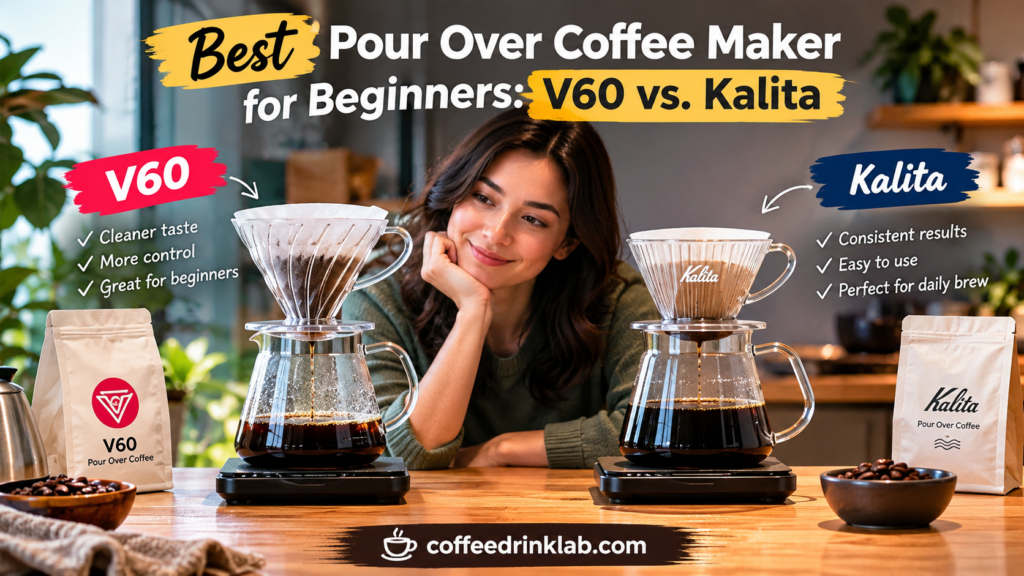
The V60 makes sense if you want to learn how water flow and pouring technique affect extraction. Meanwhile, the Kalita Wave is a better fit if you want reliable results without constantly adjusting your pouring pattern.
Neither is universally “better.” Instead, think about how much control you actually want.
| Feature | V60 | Kalita Wave |
|---|---|---|
| Learning curve | Moderate | Easier |
| Cup character | Bright and clear | Balanced and sweet |
| Pouring control | High | Moderate |
| Beginner friendly | Good with practice | Excellent |
| Experimentation | Excellent | Very good |
If you enjoy the process as much as the finished coffee, the V60 is especially rewarding. If your priority is repeatability, the Kalita Wave is a safer starting point.
Best Pour Over Coffee Maker Automatic
An automatic pour-over-style coffee maker is different from a traditional hand-poured dripper. Instead of controlling every pour yourself, the machine manages water delivery and extraction automatically.
This category is useful for people who like pour-over-style coffee but don’t want to stand over a kettle every morning. Modern machines can reproduce controlled water distribution while offering programmable brewing and temperature adjustments.
For example, newer automatic brewers are increasingly designed to imitate the controlled movement of a barista’s hand. Cosori’s Juni, introduced in 2026, uses a moving dispensing system designed to reproduce a spiral-style pour and offers programmable and customizable brewing features.
The important distinction is simple: if you want the ritual and control of manual brewing, choose a dripper. If you want convenience and repeatability, an automatic brewer may make more sense.
Best Pour Over Coffee Maker Under $100
You do not need a large budget to make excellent pour-over coffee. In fact, simple ceramic, glass, or plastic drippers can produce impressive results when paired with fresh beans, good filters, and properly heated water.
Budget shoppers should prioritize the brewer’s design rather than expensive branding. A good grinder and fresh coffee beans can make a bigger difference than moving from a basic dripper to a premium brewer.
A practical budget setup might include:
- Affordable V60 or Kalita-style dripper
- Paper filters
- Fresh whole-bean coffee
- Burr grinder
- Digital scale
- Gooseneck kettle
The advantage is that you can improve each component gradually instead of spending hundreds of dollars at once.
1. Best Pour Over Coffee Maker Under $500
Once you move toward the mid-range and premium category, you’re paying more for materials, consistency, design, thermal performance, accessories, or automation rather than simply getting a dramatically better cup.
For most home brewers, spending the full $500 budget on the dripper alone is unnecessary. A more balanced setup could put some of the budget toward a quality grinder, temperature-controlled kettle, scale, and brewer.
This is especially important because pour-over coffee is sensitive to grind consistency. A premium brewer cannot completely compensate for poorly ground coffee.
1. Best Pour Over Coffee Maker Under $1000
At the $1,000 level, you are entering specialty equipment territory, including sophisticated automatic brewers and complete brewing systems. However, that does not mean a $1,000 machine automatically produces better coffee than a simple V60 or Kalita Wave.
If convenience is your priority, a high-end automatic brewer can justify the additional cost. If experimentation is what you enjoy, however, a manual setup may give you more control for considerably less money.
In other words, $1,000 is a convenience and refinement budget, not a requirement for excellent pour-over coffee.
Best Pour Over Coffee Maker for Bartenders and Coffee Professionals
Although bartenders may primarily work with cocktails and other beverages, a busy hospitality environment benefits from brewing equipment that is fast, repeatable, durable, and easy to clean.
For professional coffee service, consistency matters more than having the fanciest brewer. A flat-bottom brewer can be practical when several drinks need to be prepared with similar results, while larger carafe-style systems work better for batch service.
For café-style environments, also consider:
- Brewing capacity
- Filter availability
- Cleaning speed
- Replacement-part availability
- Consistency between batches
- Counter space
- Heat retention
A professional setup should fit the workflow rather than simply look impressive on the counter.
Best Pour Over Coffee Maker for Camping and Travel
Camping changes the priorities completely. Instead of focusing on maximum brewing precision, you’ll probably care more about weight, durability, compact storage, and how easily the brewer can be cleaned.
Lightweight plastic or collapsible brewers can be practical for travel, while stainless-steel options can handle rougher conditions. If you specifically want to avoid plastic, look for compact metal or glass equipment, but remember that glass is more fragile during transport.
For camping, a good setup should be:
- Lightweight
- Compact
- Durable
- Easy to rinse
- Compatible with your heat source
- Simple to pack
For longer trips, a hand grinder can also make sense because whole beans preserve freshness better than carrying pre-ground coffee for an extended period.
How to Choose the Right Pour Over Brewer
Choosing the best pour over coffee maker starts with your preferred coffee experience. If you enjoy bright, transparent flavors and experimenting with your technique, a V60-style brewer is an excellent match.
If you want something easier and more consistent, a flat-bottom brewer such as the Kalita Wave is worth considering. For larger groups, a Chemex makes more sense because the brewing and serving vessel are combined.
Your filter preference matters too. Paper filters create a cleaner cup, while reusable metal filters generally allow more oils through. Meanwhile, automatic brewers are ideal if you like the flavor profile associated with pour-over but prefer pressing a button instead of manually controlling every pour.
Most importantly, don’t overlook the grinder. Fresh beans, a consistent grind, accurate measurements, and appropriate water temperature often have more influence on the finished drink than the price of the brewer.
What Is the Best Pour Over Coffee Maker?
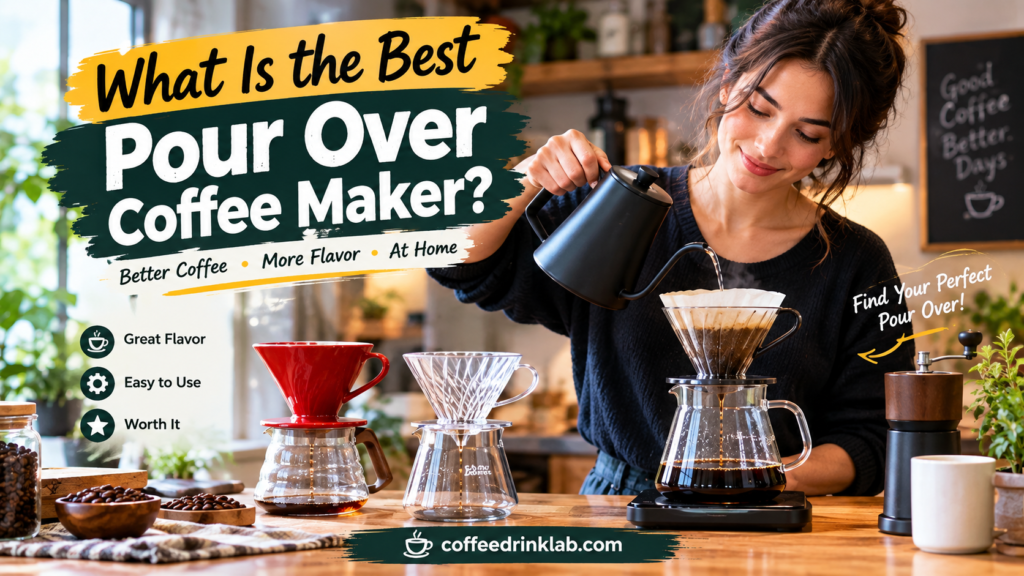
So, what is the best pour over coffee maker? There is no single winner for every coffee drinker.
The Hario V60 is a strong overall choice for people who want control and a huge amount of brewing flexibility. The Kalita Wave is better for someone who values consistency, while the Chemex is especially attractive for larger batches and a very clean cup.
For beginners, the Hario Switch can be particularly useful because it provides both immersion and pour-over-style brewing. Meanwhile, automatic machines are better suited to people who want convenience rather than a hands-on ritual.
The right choice ultimately depends on how you drink coffee, how many cups you make, and how much control you want.
Quick Comparison of the Best Pour Over Coffee Maker Options
| Brewer type | Best for | Skill level | Capacity | Main advantage |
|---|---|---|---|---|
| Hario V60 | Experimentation | Intermediate | Small-medium | Excellent control |
| Kalita Wave | Everyday brewing | Beginner | Small-medium | Forgiving design |
| Chemex | Groups | Beginner-intermediate | Medium-large | Clean, elegant brew |
| Hario Switch | Beginners | Beginner | Small-medium | Hybrid brewing |
| Origami | Experimenters | Intermediate | Small-medium | Filter flexibility |
| Automatic brewer | Convenience | Beginner | Medium-large | Consistency |
This comparison also shows why there is no universal winner. Your ideal brewer should make the kind of coffee you enjoy while fitting naturally into your daily routine.
The Final Talk
The best pour over coffee maker is the one that fits your routine, taste, and willingness to experiment. A V60 is fantastic if you want to learn the craft and adjust every part of the brew, while a Kalita Wave can make the process more forgiving. Meanwhile, a Chemex is a beautiful option for serving several people, and a Hario Switch gives beginners room to explore different brewing methods.
You also don’t need to spend hundreds of dollars to make excellent coffee. Fresh beans, a consistent grinder, good water, accurate measurements, and a little patience can transform an affordable brewer into a seriously enjoyable setup. If you’re just getting started, choose the brewer that feels easiest to use rather than the one with the longest feature list.
Ultimately, pour-over coffee is as much about the process as the cup. Try one style, adjust your grind and pouring technique, and give yourself time to learn what your favorite coffee tastes like.
FAQs:
For many beginners, the Kalita Wave or Hario Switch is a comfortable starting point because both can make consistent coffee without demanding advanced pouring skills. The V60 is also an excellent beginner brewer if you enjoy learning through experimentation.
Start with your preferred serving size and brewing style. Then consider whether you want maximum manual control, an easier learning curve, reusable filtration, plastic-free materials, travel portability, or automatic brewing.
Yes. Pour-over brewing is especially well suited to home kitchens because the equipment can be compact and relatively inexpensive. You only need a compatible brewer, filter, coffee grounds, hot water, and a cup or server.
The most recognizable options include the Hario V60, Kalita Wave, Chemex, Hario Switch, and Origami. Each has a different brewing style, so popularity does not necessarily mean one model is right for everyone.
The biggest differences are shape, filter design, drainage, capacity, material, and how much control the brewer gives you. Cone brewers such as the V60 emphasize pouring technique, while flat-bottom designs such as the Kalita Wave tend to be more forgiving.
Discover More Blends
Stray Dogs Coffee: Menu & Riverside Guide
Shadow Box Coffee Table: Styles & Storage
Dazbog Coffee: Best Blends & Menu Guide







2 Comments