

Understanding Your Coffee Routine: Caffeine, Grind Size & Better Brewing
Coffee has become an important part of everyday life for people around the world. For some, it is the first drink of the morning, while for others, it is an afternoon ritual, a social experience, or a way to enjoy a quiet moment during a busy day. Although making coffee can seem simple, the quality of the final cup depends on many small details. The type of beans, grind size, water, brewing method, serving size, and even storage conditions can all influence the taste and overall experience.
Understanding these details can help you become a more confident coffee drinker. You do not necessarily need expensive equipment or complicated techniques. In many cases, learning a few basic principles and making small adjustments can significantly improve your coffee routine.
This guide explores the relationship between caffeine, grind size, brewing methods, and everyday preparation habits. It also explains how simple tools can make it easier to understand your coffee consumption and improve the way you prepare each cup.
Why Coffee Preparation Matters

It is easy to assume that good coffee simply requires good beans. While quality beans are certainly important, they are only one part of the process.
Imagine using excellent coffee beans but grinding them incorrectly for your brewing method. The result may still taste weak, sour, bitter, or unbalanced. Similarly, using poor-quality water or allowing coffee to sit on a hot surface for too long can negatively affect the final flavor.
Coffee brewing is essentially a process of extracting desirable compounds from roasted beans using water. The way this extraction happens depends on several variables.
These include grind size, water temperature, brewing time, coffee-to-water ratio, and brewing technique. Once you understand these variables, it becomes much easier to identify problems and make improvements.
Understanding Your Caffeine Consumption
Caffeine is one of the main reasons people drink coffee. It is a naturally occurring stimulant found in coffee beans as well as tea, chocolate, energy drinks, and several other products. However, caffeine content is not identical across all coffee beverages.
A small espresso, a large mug of drip coffee, and a glass of cold brew may contain very different amounts of caffeine. Even coffees prepared using the same method can vary depending on the type of beans, serving size, recipe, and amount of coffee used. For people who consume several caffeinated beverages throughout the day, simply counting cups may not provide an accurate picture of total intake.
This is where a caffeine calculator can be useful. By entering the beverages you consume and their approximate serving sizes, you can estimate your daily caffeine intake and get a better understanding of how much caffeine is coming from coffee and other sources.
Why Caffeine Levels Differ Between Coffees
Many coffee drinkers assume that darker or stronger-tasting coffee always contains more caffeine. Flavor intensity and caffeine content, however, are not exactly the same thing. Roast level, bean variety, brewing method, serving size, and recipe can all influence caffeine content.
Robusta coffee beans, for example, generally contain more caffeine than Arabica beans. Brewing methods also extract caffeine differently. A large serving of brewed coffee can contain a considerable amount of caffeine simply because the serving contains more liquid and coffee grounds than a small espresso.
Cold brew can also be confusing because it is often prepared as a concentrate and diluted before drinking. This is why comparing coffee based solely on taste can be misleading.
Coffee and Your Daily Routine
Coffee can fit into many different lifestyles. Some people enjoy one cup in the morning, while others drink several throughout the day. The important thing is understanding how your individual routine affects you.
Some people are highly sensitive to caffeine and may notice changes in sleep or feelings of restlessness after relatively small amounts. Others can consume caffeine later in the day without noticing the same effects.
Paying attention to timing can therefore be just as useful as paying attention to quantity. If you regularly experience difficulty sleeping after drinking coffee in the evening, experimenting with an earlier final serving may be worth considering.
The Importance of Grind Size
Caffeine is only one part of the coffee equation. If you want to improve flavor, grind size is one of the most important variables to understand. Whole coffee beans need to be ground before brewing. The size of the resulting particles determines how quickly water can interact with the coffee.
Fine grounds expose more surface area to water, which generally allows extraction to happen more quickly. Coarse grounds have larger particles and generally slow the extraction process. This is why espresso requires a very different grind from French press coffee.
Using the wrong grind can make it difficult to produce a balanced cup, even if the beans themselves are excellent.
Choosing the Right Grind for Your Brewing Method
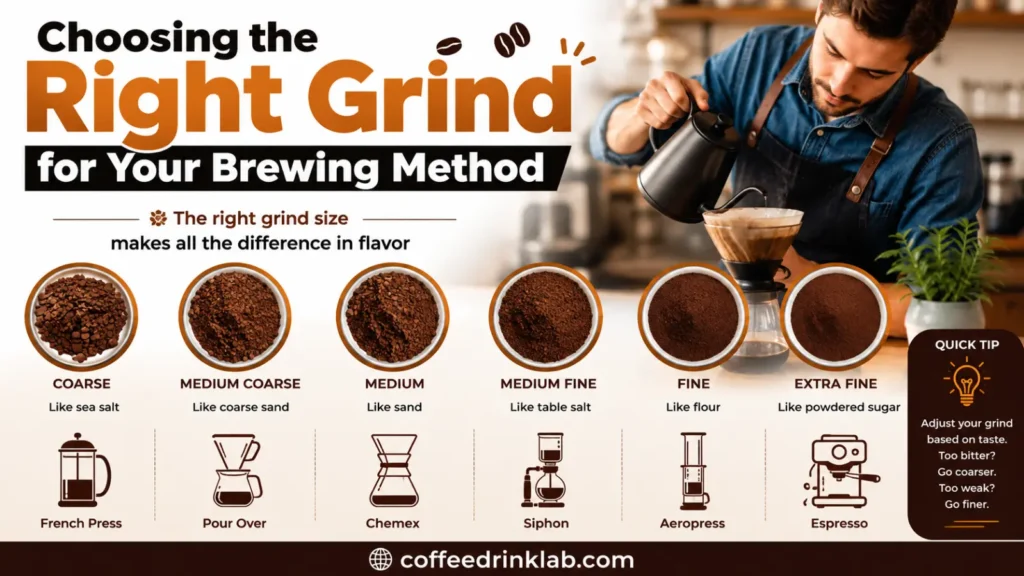
Different brewing methods require different starting points. Espresso generally uses a fine grind because water passes through the coffee under pressure over a relatively short period. French press usually benefits from a coarse grind because the coffee remains immersed in water and is later separated using a metal filter.
Pour-over brewing often uses a medium or medium-fine grind, although the exact setting depends on the brewer, filter, recipe, and coffee. Cold brew generally uses a coarse grind because the grounds remain in contact with water for a much longer period. There are exceptions to all of these guidelines, which is why experimentation remains an important part of coffee brewing.
Finding a Starting Point With a Grind Calculator
Choosing a grinder setting can be confusing, especially because grinder numbers are not standardized. A setting of 10 on one grinder may produce a completely different particle size from a setting of 10 on another. A coffee grind size calculator can help simplify this process by providing a recommended starting range based on your brewing method.
The recommendation should not be treated as an absolute rule. Instead, use it as a starting point and then adjust the grind according to your coffee’s taste and brewing behavior. If the coffee is too sour and the brew finishes very quickly, a slightly finer grind may help. If it tastes harsh or bitter and takes too long to brew, moving slightly coarser may be worth trying.
Learning to Recognize Extraction Problems
Taste is one of the most useful tools available to a coffee drinker. When coffee tastes sour, sharp, or unusually thin, it may be under-extracted. This means the water did not extract enough desirable compounds from the grounds. When coffee tastes extremely bitter, dry, or harsh, it may be over-extracted.
These problems can sometimes be addressed by adjusting grind size, but other factors may also be responsible. Water temperature, brewing time, coffee dose, and pouring technique can all affect extraction. For this reason, avoid changing multiple variables at the same time.
Practical Habits for Better Coffee
Improving your coffee does not require a complicated routine. Several simple habits can make a noticeable difference. One of the most useful coffee tips is to start with fresh beans and grind them shortly before brewing. Freshly ground coffee generally retains more aroma than coffee that was ground long before preparation.
Another useful habit is measuring your coffee and water instead of relying entirely on visual estimates. A consistent ratio makes it easier to reproduce a successful recipe. Good water is also important. If your water has a strong taste or odor, it can influence the flavor of your coffee. Filtered water can provide a cleaner foundation.
Keeping your equipment clean is equally important. Coffee oils and residue can build up inside grinders, brewers, and filter baskets and eventually affect the flavor of fresh coffee.
Store Coffee the Right Way
Coffee can lose freshness when it is exposed to air, moisture, heat, and light. For this reason, coffee should be stored in a sealed container in a cool, dry location. Avoid leaving an open coffee bag next to an oven, stove, or other source of heat.
Buying smaller amounts can also be helpful if you do not consume coffee quickly. There is little benefit in purchasing a huge quantity if the beans will remain unused for months. Whole beans generally retain their freshness better than ground coffee because grinding increases the amount of surface area exposed to air.
Water Quality Can Change the Flavor
Coffee is mostly water, which means water quality should not be ignored. If your water tastes good when you drink it by itself, it will generally provide a better starting point for brewing than water with a strong chemical or mineral taste.
Filtered water is often a practical option for home brewing. You also need to consider mineral content. Water that contains extremely high or extremely low mineral levels can behave differently during extraction.
You do not need to become a water chemistry expert to make better coffee, but paying attention to the water you use can help explain why the same beans sometimes taste different in different locations.
Brewing Temperature and Time
Water temperature and brewing time work closely with grind size. Hotter water generally extracts coffee compounds more quickly, while cooler water tends to slow extraction. Likewise, longer contact between water and coffee can increase extraction, while shorter contact reduces it.
This is why a fine grind combined with a long brewing time may produce a very different result from a coarse grind with a short brewing time. Instead of treating each variable separately, think of them as parts of one brewing system.
Why Consistency Is So Important
Consistency is one of the best ways to improve your coffee. If you change your coffee dose, water amount, grind, temperature, and brewing time every morning, it becomes difficult to understand why one cup tastes better than another. Try keeping most variables consistent while changing one thing.
For example, keep the same beans, water, and recipe while adjusting only the grind. Taste the difference. Once you understand how the grind affects the cup, return to your original setting and experiment with another variable. This approach makes coffee brewing much easier to understand.
You Do Not Need Expensive Equipment
Coffee equipment can become extremely expensive, but better coffee does not automatically require premium equipment. A good grinder, fresh beans, clean equipment, suitable water, and a consistent recipe can take you a long way.
Before purchasing another piece of equipment, consider whether you have already optimized the basics. Sometimes the biggest improvement comes from something as simple as grinding your beans immediately before brewing or using a more consistent coffee-to-water ratio.
Experiment With Different Coffee Styles
Once you understand the fundamentals, experimenting becomes much more enjoyable. Try beans from different origins and compare their flavor profiles. Experiment with light, medium, and dark roasts. Try pour-over if you normally drink French press.
If you usually drink hot coffee, experiment with cold brew. Different methods can highlight completely different characteristics in the same type of bean. There is no single brewing method that everyone must prefer. Coffee is ultimately a personal experience.
Keep Notes About Your Favorite Recipes
If you enjoy experimenting, consider keeping a simple record of your brewing recipes. Write down the coffee you used, grind setting, dose, water amount, brewing time, and your impression of the flavor. Over time, these notes can help you identify patterns.
You may discover that you prefer certain roast levels, particular origins, or specific brewing ratios. This can also save time because you can return to recipes that worked well instead of starting from scratch every time.
Final Thoughts
Better coffee does not come from one secret technique. It comes from understanding the small details that influence the final cup.
Being aware of your caffeine consumption can help you better understand your daily coffee habits. Learning about grind size can make different brewing methods easier to control. Developing simple preparation and storage habits can improve consistency and preserve the quality of your beans.
A thoughtful approach to coffee allows you to experiment without making the process unnecessarily complicated. Start with fresh beans, use appropriate grind sizes, pay attention to water and brewing time, and make one change at a time.
Most importantly, remember that coffee is meant to be enjoyed. Use the available tools and information as guides, but let your own taste preferences determine what makes the perfect cup for you.
FAQs
Good-tasting, clean water is a good starting point for brewing coffee. Filtered water can be useful when tap water has a strong taste or odor. Water mineral content can also influence extraction and the final flavor.
Under-extracted coffee may taste sour, sharp, or thin, while over-extracted coffee can taste bitter, harsh, or dry. Adjusting grind size, brewing time, water temperature, or coffee-to-water ratio can help improve extraction.
Caffeine levels vary by serving size, bean type, brewing method, and recipe. Robusta beans generally contain more caffeine than Arabica beans. A large serving of brewed coffee can also contain more total caffeine than a small espresso because of its larger serving size.
The ideal grind size depends on the brewing method. Espresso generally requires a fine grind, pour-over usually works with a medium to medium-fine grind, and French press and cold brew commonly use a coarse grind. Your grinder and recipe may require some adjustment.
Yes, grind size can affect caffeine extraction because it changes how quickly water interacts with the coffee grounds. However, caffeine content also depends on the coffee dose, brewing method, water-to-coffee ratio, and brewing time.
Discover More Blends
Cuisinart Coffee Maker Filter: Types, Sizes, Cleaning & Replacement Guide
Reusable Coffee Filter: Best Options & Guide
Fireproof Coffee Redlands: Menu, Hours, Photos & Reviews (2026 Guide)
ViLand Coffee: Menu, Beignets & Drinks Guide




3 Comments